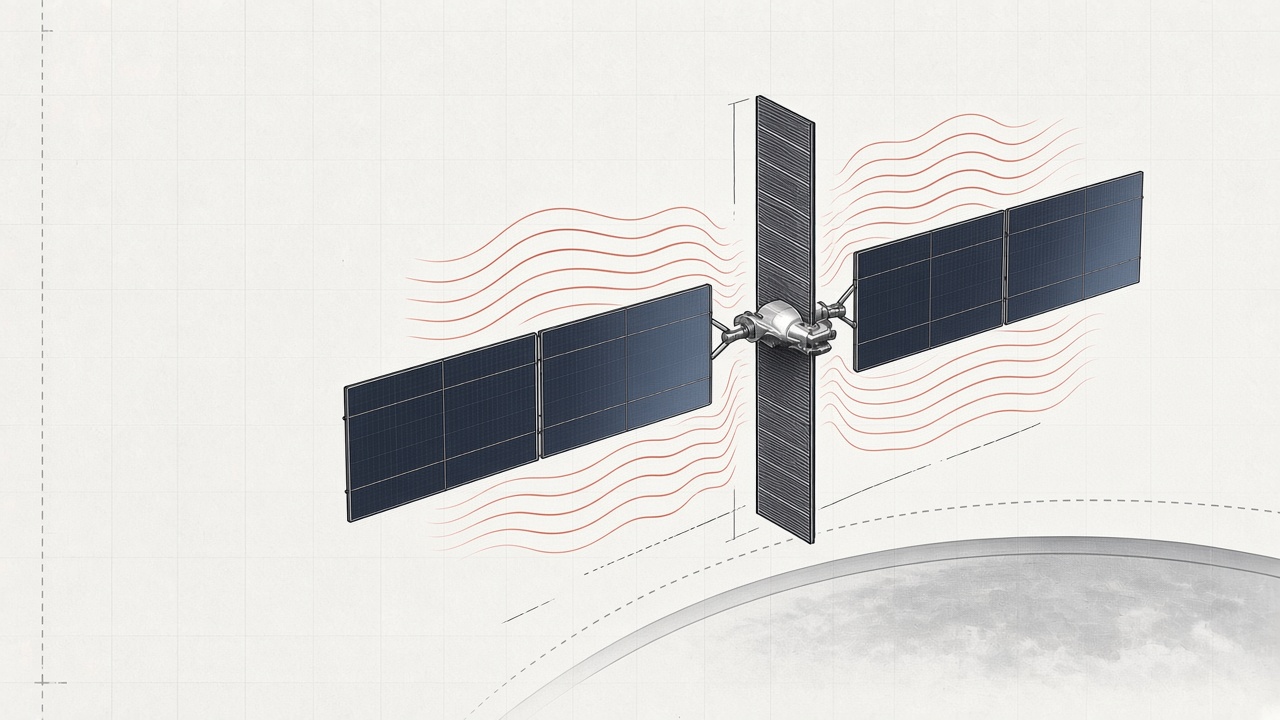
Every watt becomes heat. In space, the only way out is to radiate it.
New to this? Start with Your laptop in space, the plain-language version.
Every conversation about industry in space (computing, refining, manufacturing) eventually becomes a conversation about heat. Electricity is the easy part. A wire carries it across a spacecraft almost for free, and when distance gets expensive you raise the voltage. Heat has no cheap equivalent. Left to itself it flows downhill in temperature, every interface it crosses takes a toll, and in vacuum the only way out is to radiate it, at a rate that scales with the fourth power of temperature. A heat pump can lift it to a hotter, smaller radiator, but only by spending more electrical power; this model doesn't include one yet.
I built this explorer to make that intuition quantitative. It follows the energy from the solar array, through the payload, down the temperature staircase, to the radiator, and shows which assumptions actually move the size and mass of the hardware. One number sums up the thermal side: watts of heat rejected per kilogram of radiator and pumped loop. This model's ISS-heritage case manages about 8 W/kg; Watts per kilogram shows what limits it and where the room is. It started as a question about orbital data centers. I want it to grow into a tool for any energy-hungry work in cislunar space and, eventually, on the Moon.
It is a companion to Andrew McCalip's Space Datacenters, which asks whether orbital compute pays. This one asks what the heat and power hardware has to look like. Every number carries a source or a label (see Assumptions). Please check the math, challenge the assumptions, and send me better numbers.
SpaceX's Starmind is a reference case because it is the most talked-about design, and SpaceX has shared more of its numbers than anyone else: power, radiator and solar array areas, kW per ton, orbit. Credit where it's due. Where this model and their figures disagree, that is a question about assumptions, not a verdict on their design. I'd like cases for the others too: Starcloud, Sophia Space, Cowboy Space (formerly Aetherflux), Relativity Space, Blue Origin's Project Sunrise, Google's Project Suncatcher, Axiom Space, and anyone else with published figures. If you can source their numbers, please add a case.
Note: Built from publicly available information and first-principles physics. No proprietary data. These are my personal views.
Try this first. In the Starmind case, lower the source temperature limit and watch the radiator area grow. Then open the temperature staircase to see where the temperature budget goes.
Reference case

| Part | Inputs | Output |
|---|---|---|
| Heat path | heat source, temperature limit, power per package, coolant loop | coolant temperature T |
| Radiator | ε, α, fin efficiency, orientation, sizing margin, areal density; what it sees (location) | heat rejected per m² at T, so radiator area |
| Power supply | cells, bus voltage, battery; sunlight (location) | solar array area, battery mass |
| Shared | heat load Q (total load ÷ conversion efficiency), location | feeds the radiator and the power supply |
| Results | all of the above | mass budget, solar array : radiator area, sensitivity |
Part 1
Everything between the heat source and the fluid that reaches the radiator. Its only output is the coolant temperature T, and every kelvin it spends shrinks what the radiator can do.
Heat flows downhill in temperature: ΔT = Q × R, thermal Ohm's law. Every interface spends part of a small, fixed budget, the source limit minus the radiator temperature. Most of it is spent within a centimeter of the heat source: silicon, interface materials, lid, cold plate. Distance itself costs little once heat is in a pumped loop.
Each line is a 1 kW path from source to panel, scored as the share of ideal panel area doing useful work. A wire loses almost nothing over distance, because voltage can be stepped up. Heat has no cheap transformer (a heat pump costs power): a 10 × 10 cm solid copper bar cannot carry 1 kW much past a metre, and a pumped loop makes distance cheap but still pays the fixed interface staircase.
Part 2
How much heat each square metre rejects at temperature T, given what the radiator sees. With the heat load Q, that sets the radiator area.
Net heat rejected per m² of two-sided panel, versus the radiating fluid temperature, in each environment. Flux grows as T⁴, so hot waste heat is cheap to reject. A warm view (Earth, the lunar dayside, sunlit regolith) cancels the low-temperature end of the curve. On the lunar equator at noon, a vertical fin with the Starmind-mode surface properties absorbs more than it emits below about 335 K (curves that drop off the log scale have gone net-negative).
A radiator near a body sees part of it instead of 3 K space and absorbs its infrared. Edge-on panels see less than panels facing the body. The penalty fades with altitude, and is larger for colder radiators. This model keeps radiators knife-edge to the Sun; Pointing a radiator at the Sun shows what happens when you don't.
Part 3
The solar array and battery that deliver the load through light and dark. The location sets the sunlight; the heat load Q sets the power.
The β angle between the orbit plane and the Sun sets how long each eclipse lasts. Above a critical β the spacecraft never enters the planet's shadow: no eclipse-storage requirement, and no oversized solar array to recharge a battery. A dawn–dusk sun-synchronous orbit flies along the terminator to stay there. The radiator barely notices, so the case for terminator orbits rests on power. Not modelled here: eclipse thermal cycling of chips and radiators, and losing compute in the dark.
Results
These charts combine all three parts, so they have no inputs of their own. Change anything above and they move.
Same scenario, sweeping only the heat source's temperature limit. The solar array is fixed by the power drawn. The radiator shrinks steeply with temperature. Chips are pinned near 350–400 K, so without a heat pump compute pays nearly full price. A heat pump could lift the radiator above the source temperature by spending electrical power, which grows the solar array; this model does not include that trade. For a process rejecting heat at 600 K or more, the radiator becomes small next to the solar array.
Payload mass is excluded on purpose. Per m², radiators weigh several times more than solar arrays, so a 5:1 area ratio is not a 5:1 mass ratio. In darkness-heavy environments, energy storage can outweigh both. Storage for brief power peaks is not included.
Each bar moves one parameter down or up by one step and holds everything else fixed. Steps are in natural units: ±10 K on temperatures, ±0.05 on emissivity, ±20 % on areal densities. Hover a bar for the value tried.
Space is cold, but it is a vacuum: there is no air or water to carry heat away. The only way out is to radiate it, and at 60 °C that moves about 7.5 W per m² for each degree of temperature difference, about the same as still air around a laptop with its fan off. A 132 kW GPU rack would need about 105 m² of radiator at 60 °C; its footprint is 0.64 m². Your laptop in space walks through it.
Mostly in the first centimeter. In this model's Starmind case, starting from a chip limited to 100 °C, the silicon, thermal interface, lid and cold plate spend about 31 K before the heat reaches the coolant, and the whole path to the radiator about 37 K. Near 60 °C, every kelvin spent there costs about 1.2 % more radiator area, because radiated power goes as T⁴, and the costs compound: the full 37 K makes the radiator about 57 % larger than one radiating at the chips' 100 °C limit, 321 m² instead of 205 m². Chart 1 shows the staircase.
The physics agrees with it: this model's radiator rejects SpaceX's stated ~1,400 W/m² with its fluid at about 85 °C. The open question is the heat path. An Earth-style lidded chip package at a 100 °C junction delivers about 63 °C to the radiator here. Closing that gap takes a heat path that spends less temperature, chips that run hotter, or peaks carried by the battery and thermal mass. Mach33's independent model lands in the same place: holding 105 °C GPU logic and 95 °C memory at 250 kW takes about 327 m² of radiator, against 321 m² here. The Starmind check shows the numbers.
The Sun covers about 0.001 % of what a radiator face sees, so it barely blocks the cold sky. But it delivers 1,361 W/m². A white-painted panel at 60 °C, turned face-on to the Sun, loses about 22 % of what it could reject in the dark. Knife-edge to the Sun it loses nothing, which is why designs fly their radiators that way. Pointing a radiator at the Sun lets you turn it.
Less than you might think, if the panel is edge-on. At 600 km and 60 °C, Earth's infrared and reflected sunlight cost about 9 % of a two-sided panel's rejection. Turn one face to Earth and that face absorbs about 3.4 times as much. Chart 4 shows how the cost fades with altitude.
Because heat has no cheap transformer. Conducting heat through copper with a 50 K budget behaves like distributing electricity at about 21 millivolts, and a solid 10 × 10 cm copper bar cannot carry 1 kW much past a meter. A pumped loop carries the heat in moving fluid instead, so distance costs pump power, not temperature. Chart 2 compares them.
It's an area ratio, and it depends on what you count. Elon Musk put it as about 1,300 W/m² from an aluminum radiator against about 250 W/m² from solar panels, so the panels should have "~5 times the area of the radiator". At 60 °C a two-sided radiator facing the dark sky rejects about 1,257 W/m², which gives 5.0 : 1, and SpaceX's Starmind figures work out to 5.25 : 1 (840 m² of solar array against 160 m² of radiator). This model's Starmind case comes out at 2.4 : 1, mostly because it sizes the radiator for the 250 kW peak but the solar array for the 175 kW average, and adds a 25 % sizing margin; fin losses and Earth's warmth do the rest.
Elon Musk says so, and Mach33's reconstruction of the earlier 150 kW design put the thermal hardware at about a quarter of the satellite (about 532 kg of 2.1 t). This model's Starmind case says the opposite: 1.9 t of radiator and 1.4 t of pumps and plumbing against 1.5 t of solar array. The difference is two assumptions SpaceX hasn't published: 6 kg per m² of radiator and 5 kg per kW of pumps and plumbing. At SpaceX's published areas, the solar array outweighs the thermal hardware once pumps and plumbing drop below about 2.6 kg per kW. Both are labelled assumptions with a Challenge link.
Watts of heat rejected per kilogram of radiator and pumped loop. This model's ISS-heritage case reaches about 8 W/kg, its Starmind case about 83 and its aggressive case about 190. Physics caps the heat per square meter, at about 1,000 W/m² at 50 °C in low orbit, so watts per kilogram mostly comes down to mass per square meter, and the pumps set a ceiling of their own. Watts per kilogram maps it.
Lighter radiators and pumps: ranked by W/kg, chart 8 puts radiator mass per square meter first. Hotter chips, because every kelvin of radiator temperature is worth about 1.2 % of area. And heat pumps, which lift heat to a hotter, smaller radiator by spending electrical power; this model does not include them yet.
Tags: [source] cited reference · ASSUMPTION engineering judgement · CALIBRATED tuned to reproduce a published figure · SECONDARY widely quoted, not confirmed against a primary source. Select a parameter's name () to read what it means.